Download our brochure
What Is a Battery Stacking Machine vs a Battery manufacturing platform ?
A battery stacking machine assembles alternating anode, separator and cathode layers to form the electrode stack of a battery cell. Depending on the cell architecture, materials and production objectives, the equipment may use individual sheet stacking or a continuous Z-folding process.
In addition to feeding and positioning the layers, a configurable stacking platform can integrate cutting, pressing, wrapping, tab welding, testing, encapsulation and electrolyte filling operations.
In brief : a battery stacking machine creates the layered electrode stack used in pouch cells and other stacked battery designs a battery stacking platform integrates several additional parocesses and one line tests.


Develop Your Stacking Process Without Freezing Its Future Configuration Without Freezing Its Future Configuration
Early-stage battery projects require flexible equipment to test cell designs, validate materials and refine process parameters before industrial scale-up. However, material behaviour, cell chemistry and assembly requirements may evolve considerably during development.
A fixed production system can limit the ability to evaluate new scenarios, use peculiar material or introduce intermediate operations. The Next Gen Line provides a modular starting point that secures the processes already identified while preserving the ability to add, replace or reorganize functions as the project develops.
Are your materials, stack dimensions or future process steps still evolving ?
Our teams can help you define a modular starting configuration without limiting future upgrades.
Next Gen Line : A Modular Battery Stacking Platform
Huguet’s Next Gen Line is a modular battery prototyping platform designed for stack preparation and stacked cell assembly. Embedded stations and connectable modules can be combined to reproduce the assembly sequence required by each project.
R&D and industrialization teams can progressively build their process, assess critical operations and adjust key parameters before preparing for a larger production scale. Each configuration is developed according to the cell format, materials, selected stacking method and targeted level of automation.


Choose the Stacking Process suited to your Cell Design and keep the possibility to change your mind
Sheet-by-Sheet Stacking
Sheet-by-sheet stacking assembles individually cut electrodes and separator layers in a controlled sequence. This method provides flexibility when testing different layer configurations, materials or stack dimensions. It is particularly relevant for R&D projects requiring frequent adjustments.
Z-Fold Stacking
Z-fold stacking positions electrode sheets within a continuous separator folded alternately around the anode and cathode layers. The method supports separator continuity and repeatable electrode placement, subject to the behaviour of the selected materials.
Comparison
Criterion
Sheet-by-sheet
Z-fold
Separator configuration
Individual sheets or project-specific configuration
Continuous folded separator
Development flexibility
Very high
Dependent on material and foldability
Typical use
Variable designs and experimental sequences
Repeated layered assembly
Compatibility
Validated per material and cell design
Validated per material and cell design
Next-Gen Platform supports any of the stacking processes or both to best adapt user’s requirements.
Tabs on the opposite sides or on the same side
How Cell Stacking is made with Pouch format ?
A typical pouch cell stacking process includes:
- Material feeding
Electrodes, separators, solid electrolytes or multilayer components are loaded into dedicated magazines or positionned on unwinding mandrels.
- Material preparation
Protective films or carrier materials, if any, can be removed from active sheets.
- Cutting
Laser or mechanical cutting prepares the components to the required dimensions.
- Positioning and alignment
Each component is transferred and positioned before being added to the stack.
- Stack assembly
The electrodes and separators are assembled through sheet-by-sheet or Z-fold stacking. Opposite tab design or design with tabs on the same side.
- Pressing andand finalization
The completed stack can be pressed (optional), wrapped or taped.
- Electrical connection
The process can include current collector crimping and tab welding. Insulation taping (optional)
- Testing, packing and cell filling
Depending on the project requirements, electrical insulation testing, encapsulation, sealing and electrolyte filling operations can also be integrated.

Configure the Platform Around Your Process
Material Feeding and Preparation
- Sheet magazines for electrodes, separators and solid electrolytes
- Multilayer component feeding
- Removal of carriers or protective films
- Individual sheet handling
- Interchangeable tooling and components
Cutting and Transfer
- Laser cutting with individual part transfer
- Processing of lithium-metal or lithium-on-copper components
- Mechanical cutting
- Direct picking by robot or Conveyor-based magazine transfer
Stack Assembly
- Sheet-by-sheet stacking
- Z-fold stacking
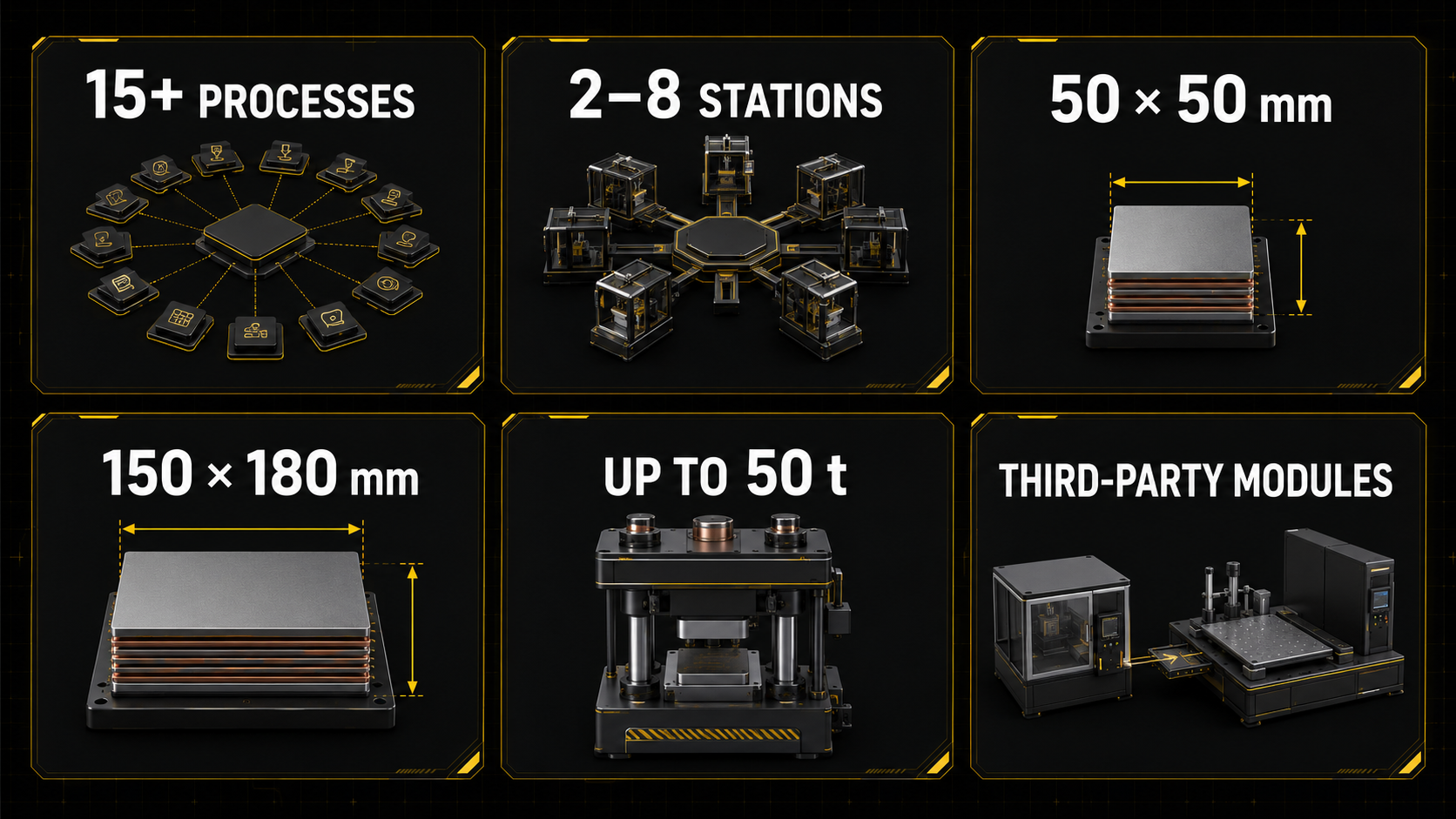
- Stack pressing up to 50 tonnes
- Final stack wrapping and taping
- Stack buffering and transfer
Electrical Connection and Inspection
- Current collector crimping
- Tab welding
- Taping
- Electrical insulation testing
Encapsulation and Completion
- Blister encapsulation
- Sealing
- Electrolyte filling and last side sealing under vacuum
Key Technical Figures
Intermediate stack dimensions can be assessed according to the materials, cell design and selected process configuration.
Designed for Lithium-Ion and Next-Generation Battery Projects
Through configurable stations and interchangeable components, the Next Gen Line can be upgraded to different cell designs, materials and battery chemistries. Applications include conventional lithium-ion pouch cells and advanced stacked cell technologies, including solid-state battery projects.
Compatibility is assessed according to material sensitivity, layer configuration, stack dimensions, processing environment and the required assembly operations.
Typical purposes of our customers
- battery research and development,
- material validation,
- pouch cell prototyping,
- solid-state cell development,
- Proof of Concept trials validation,
- process optimization,
- pilot-line preparation,
- early industrialization studies.
From Process Assessment to Equipment Validation
Huguet Battery Processes supports each project in close partnership with its customers from the initial process assessment to equipment commissioning. Its teams combine battery process knowledge with in-house engineering, automation, mechanical design, manufacturing and system integration capabilities.
- Analysis of the cell design,
- materials and objectives
- Definition of the required assembly sequence Feasibility assessment of critical operations
- Proof of Concept validation through prototyping
- Mechanical and automation engineering
- Equipment manufacturing and assembly
- Testing and Factory Acceptance
- Test Installation, commissioning and technical support
Why Work With Huguet Battery Processes ?
- European engineering and manufacturing
- More than 50 years of industrial expertise through Groupe Huguet
- In-house mechanical, automation and integration capabilities
- Battery process development and validation support
- Modular equipment tailored to each project
- Dedicated dry-room testing capabilities
- Support from initial study to commissioning
- Long-term maintenance and spare-parts services

Who Manufactures Battery Stacking Equipment ?
Huguet Battery Processes designs and manufactures modular battery stacking equipment in Europe for R&D, industrialization and early-production projects. Its Next Gen Line can combine sheet-by-sheet stacking, Z-folding and complementary processes within a scalable architecture of 2 to 8 stations.
Each battery stacking machine is engineered according to the customer’s materials, cell dimensions, assembly sequence and development objectives.